.png)

Why “Any Questions?” Is the Worst Way to End a Board Presentation
Mary Beth Hazeldine Note to Readers: Social Entrepreneurs will make presentations to their Board, Investors, colleagues to obtain money, collaboration, approval for action. This article offers some clear advice on how to win approval. N.B. Lightly edited for length. “A VP of Supply Chain reaches his final slide — a warehouse-consolidation business case, forty minutes of numbers behind him — and it reads exactly two words: “Any Questions?” He waits. The capital committee’s cha
6 days ago3 min read
Why We Need a Transformative Circular Economy
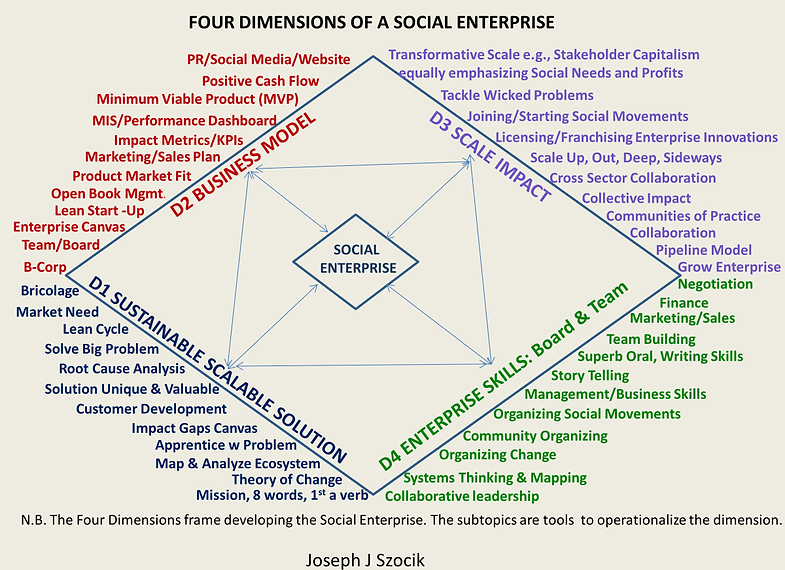
WHAT “Circular Economy (CE) is widely recognized as the new economic model aiming to maintain the value of materials, parts, and products as long as possible, minimize the extraction and use of virgin resources and waste generation using design strategies that slow the flow of resources, close loops between production and post-use, and increase resource efficiency.” WHY It can be used to Operationalize or Build out one or more of the Four Dimensions of a Social Enterprise CE
6 days ago2 min read
How to Think like a Strategic Genius
How to think like a strategic genius (a study of 82,000 cases confirms it). Álvaro García | Mental Garden 9/15/26 Note to Readers: To improve or solve a social problem the Social Entrepreneur needs to develop a strategy. Below are helpful suggestions for thinking though developing a strategy. Tip: Module 8 of the Practitioner Guide has additional information on developing a strategy. N.B. Article has been edited for length. “I want to show you a model with decades of evidence
Sep 253 min read
How to Navigate Leadership Transitions within a Collaborative?
June 3, 2026 Jennifer Splansky Juster Note To Readers: The Collaborative Impact Forum is a terrific resource for Social Entrepreneurs (SEs). Every SE will, at some point, utilize collaboration to build their positive impact on a social problem. Every collaboration is likely to undergo leadership transitions The following article provides helpful suggestions on how to manage these transitions. “Question: “We keep having so much leadership transition at key partner organizatio
Sep 113 min read
If Your MVP Survives This AI Test, It’s Worth Exploring
Jano Le Roux Feb 4, 2026 Note to Readers: Testing your product/solution to a social problem with a Minimum Viable Product (MVP) to assess real-world demand from end users/customers is an essential part of your product/solution development. The author describes how he uses aicofounder to stress test products before committing to market. Caveat: I have no experience with aicofounder. TIP: Review Module 6 in the Practitioner Guide for various experts’ advice on planning a start
Sep 34 min read
The 7 Metrics Gaslighting Your Team
Jared Blaine, Feb 17 2026 Note to Readers: A successful social enterprise that solves social problems and is financially viable requires tracking its performance with actionable metrics. NB The following article was lightly edited for length “We live in an era obsessed with data. We measure everything, from our steps to our sleep to our server response times. But in the rush to quantify success, we’ve fallen into a trap. We’ve started confusing the map with the territory. The
Aug 195 min read
What are Fayol’s 14 principles of management?
NOTE to READERS: A successful social enterprise business model has two essential tasks, produce a solution to a targeted social problem and sell it. Fayol’s 14 principles of management can assist the social entrepreneur to develop a successful social enterprise. “Henri Fayol, a French engineer, developed 14 principles of management in the early 20th century. The principles aim to give managers a set of values to emphasize in a workplace to achieve better and more efficient re
Aug 72 min read


